Premium quality.
Honest pricing.
Expert guidance.
Premium quality.
Honest pricing.
Expert guidance.
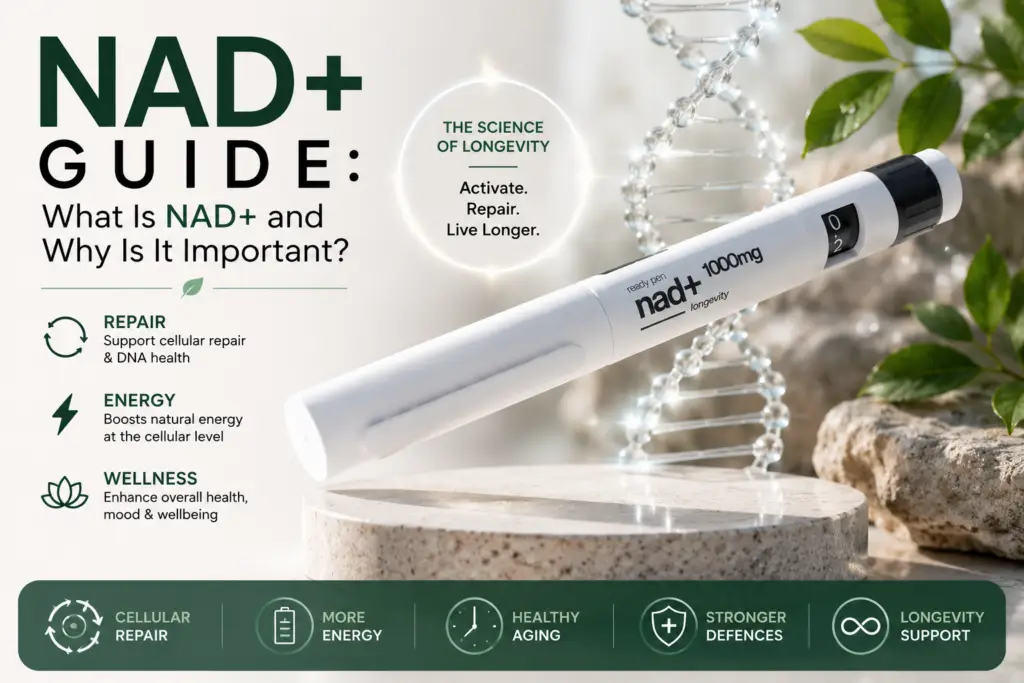
NAD+ (Nicotinamide Adenine Dinucleotide) is one of the most important molecules found naturally within the body. It plays a central role in cellular energy production and is essential for hundreds of biological processes that help cells function efficiently.
Over the past decade, NAD+ has become one of the most widely researched compounds in longevity and healthy ageing science. Researchers continue to investigate its role in energy metabolism, mitochondrial function, DNA repair, and age-related cellular processes.
This guide explains what NAD+ is, why it is important, how it works, and why it has become one of the most recognised compounds in longevity-focused research.
| Feature | Information |
|---|---|
| Category | Longevity |
| Compound | NAD+ |
| Research Focus | Cellular energy, mitochondrial function, healthy ageing |
| Delivery System | Ready Pen |
| Related Product | NAD+ 1000mg Ready Pen |
| Related Guides | Longevity Peptides Explained, MOTS-C Guide, SS-31 Guide |
NAD+ is a naturally occurring coenzyme present in almost every cell of the body.
Rather than acting like a hormone or peptide, NAD+ helps cells convert nutrients into usable energy and supports hundreds of enzymatic reactions required for normal cellular function.
Because every organ and tissue relies on cellular energy, NAD+ has become a major focus of longevity and metabolic research.
Every cell requires energy to function.
NAD+ plays a critical role in helping mitochondria—often referred to as the “powerhouses” of the cell—produce that energy efficiently.
Researchers also investigate NAD+ because it is involved in biological processes associated with:
NAD+ acts as a coenzyme that assists enzymes responsible for energy production and cellular maintenance.
Research suggests NAD+ participates in processes that help cells:
Because these functions occur throughout the body, NAD+ has become one of the most extensively studied molecules in longevity science.
Researchers commonly explore NAD+ in relation to:
NAD+ is central to the production of cellular energy required for normal biological function.
NAD+ has become a major focus of longevity research because natural NAD+ levels may decline with age.
Researchers continue to investigate the relationship between NAD+ and healthy mitochondrial activity.
NAD+ is also explored in relation to metabolism and the biological pathways involved in energy regulation.
NAD+ has become one of the most recognised longevity compounds because of its involvement in numerous biological systems.
Researchers are particularly interested in its relationship with:
Its broad role within human biology has made NAD+ one of the most researched molecules in longevity science.
Longevity research aims to better understand the biological processes associated with healthy ageing and long-term cellular function.
Because NAD+ participates in many of these processes, it has become a cornerstone of modern longevity research.
For a broader overview, read our <a href=”https://www.thesimplepeptide.com/longevity-peptides-explained/”>Longevity Peptides Explained</a> guide.
No. NAD+ is a naturally occurring coenzyme rather than a peptide. However, it is commonly discussed alongside longevity-focused peptides because of its role in cellular energy and healthy ageing research.
NAD+ stands for Nicotinamide Adenine Dinucleotide.
NAD+ plays an essential role in cellular energy production and supports numerous biological processes that help cells function efficiently.
Yes. NAD+ is naturally present in almost every cell of the body.
Researchers continue to investigate NAD+ because of its involvement in cellular energy production, mitochondrial function, DNA repair pathways, and healthy ageing research.
You may also find these guides helpful:<ul> <li><a href=”https://www.thesimplepeptide.com/buy-peptides-australia-guide/”>What Are Peptides?</a></li> <li><a href=”https://www.thesimplepeptide.com/understanding-peptide-categories/”>Understanding Peptide Categories</a></li> <li><a href=”https://www.thesimplepeptide.com/peptide-storage-guide/”>How to Store Peptides Correctly</a></li> <li><a href=”https://www.thesimplepeptide.com/metabolic-peptides-explained/”>Metabolic Peptides Explained</a> (related cellular energy pathways)</li> </ul>
NAD+ products supplied by The Simple Peptide are intended for research and educational purposes only.
The information provided in this guide is for educational purposes and should not be interpreted as medical advice. Research compounds are not intended to diagnose, treat, cure, or prevent any disease.

No matching compounds found.
Try searching by benefit, category or peptide name.