
Premium quality.
Honest pricing.
Expert guidance.
Premium quality.
Honest pricing.
Expert guidance.
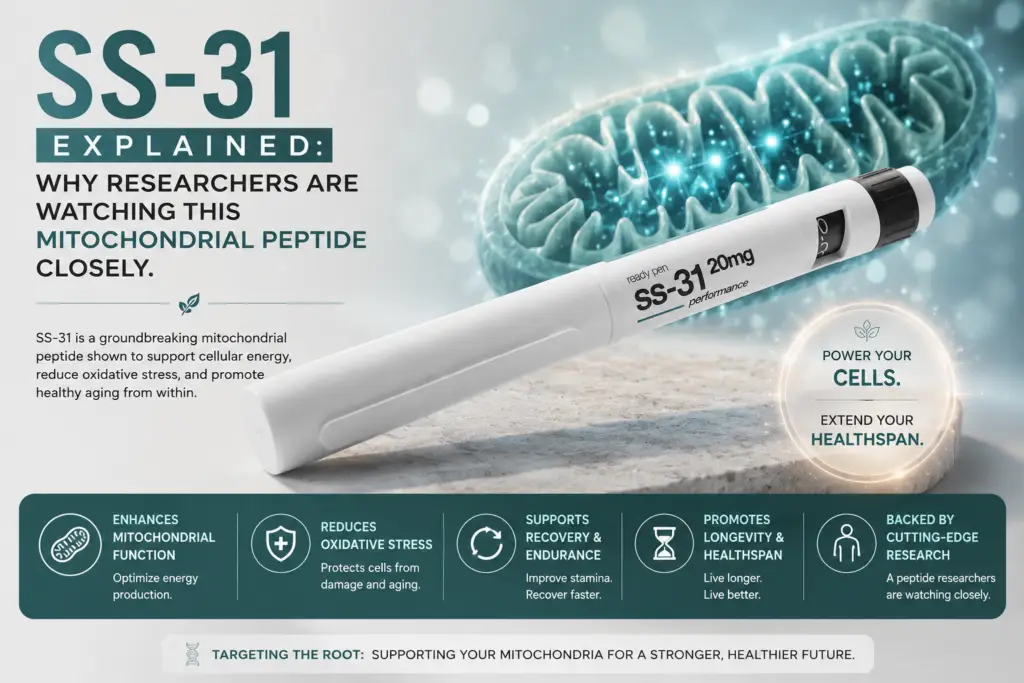
As longevity research continues to evolve, scientists are placing increasing attention on one tiny part of the cell with an enormous job: the mitochondria.
Often referred to as the “powerhouses” of the cell, mitochondria are responsible for producing the energy needed to support virtually every biological process. As a result, researchers are investigating compounds that may help improve our understanding of mitochondrial function and cellular resilience.
One compound attracting considerable scientific interest is SS-31. Unlike many peptides that are studied for a broad range of biological effects, SS-31 has become well known for its close association with mitochondrial research.
This guide explains what SS-31 is, why it has become an important area of scientific investigation, and why researchers continue to explore its potential role in healthy ageing and cellular energy.
✔ SS-31 is a mitochondrial-targeting peptide.
✔ Researchers are exploring its relationship with mitochondrial function and cellular energy.
✔ It is commonly discussed alongside NAD+ and MOTS-C within longevity research.
✔ SS-31 is one of the most recognised peptides in mitochondrial science.
✔ Research is ongoing, and scientists continue to investigate its biological mechanisms.
| Feature | Information |
|---|---|
| Category | Longevity |
| Compound | SS-31 |
| Research Focus | Mitochondrial function, cellular energy, healthy ageing |
| Delivery System | Ready Pen |
| Related Product | SS-31 20mg Ready Pen |
| Related Guides | NAD+ Guide, MOTS-C Explained, Longevity Peptides Explained (coming soon) |
SS-31 is a synthetic peptide developed for research into mitochondrial biology.
Unlike many peptides that interact with receptors on the surface of cells, SS-31 has attracted attention because researchers are investigating how it interacts with the mitochondria themselves.
Since mitochondria are responsible for producing the majority of a cell’s energy, understanding compounds that may influence mitochondrial function has become an important area of longevity science.
This unique focus has made SS-31 one of the most recognised compounds in mitochondrial research.
The growing interest in SS-31 is closely linked to its relationship with mitochondrial health.
Researchers continue to investigate how SS-31 may interact with biological processes involved in:<ul> <li>Mitochondrial function</li> <li>Cellular energy production</li> <li>Oxidative stress research</li> <li>Cellular resilience</li> <li>Healthy ageing</li> </ul>
Because mitochondria play such a fundamental role in human biology, compounds that target these structures have become an increasingly important area of scientific investigation.
Current research suggests SS-31 is able to localise to the inner membrane of mitochondria, where researchers are investigating its interactions with mitochondrial lipids and energy-producing pathways.
Scientists continue to explore how these interactions may influence mitochondrial efficiency and overall cellular function.
Although much remains to be understood, SS-31’s targeted approach is one of the reasons it has generated significant interest within longevity research.
Researchers continue to investigate SS-31 because of its close relationship with mitochondrial biology.
Healthy mitochondria are essential for producing cellular energy, making SS-31 an important compound in energy-related research.
SS-31 is commonly discussed within longevity science because mitochondrial health is considered an important area of ageing research.
Researchers are also exploring how mitochondrial-targeting peptides may contribute to maintaining normal cellular function under various physiological conditions.
Scientific interest in SS-31 has grown steadily over the past two decades.
Researchers have investigated the peptide across preclinical and clinical settings to better understand mitochondrial biology and cellular energy production.
Rather than focusing on a single biological pathway, SS-31 has become recognised for its targeted relationship with the mitochondria themselves, making it one of the most distinctive compounds within longevity research.
Unlike many peptides that act through cell surface receptors, SS-31 is being investigated because of its close association with the cell’s energy-producing structures.
This has made it a valuable research tool for scientists studying:
As research into longevity continues to grow, SS-31 remains one of the most closely watched mitochondrial peptides.
Although both compounds are associated with mitochondria, they are fundamentally different.
MOTS-C is a naturally occurring mitochondrial-derived peptide involved in cellular signalling.
SS-31 is a synthetic peptide designed for mitochondrial research.
Rather than competing compounds, they are commonly explored for different aspects of mitochondrial biology and are often discussed together within longevity research.
Yes. SS-31 is a synthetic peptide developed for mitochondrial research.
Researchers are investigating SS-31 because of its unique relationship with mitochondrial membranes and cellular energy production.
SS-31 is commonly explored in relation to mitochondrial function, cellular energy, healthy ageing and cellular resilience.
No. Unlike MOTS-C, SS-31 is a synthetic peptide developed for research purposes.
No. Although both are associated with mitochondrial research, they have different origins and mechanisms of scientific interest.
<p>You may also find these guides helpful:</p>
<ul>
<li><a href=”https://www.thesimplepeptide.com/buy-peptides-australia-guide/”>What Are Peptides?</a></li>
<li><a href=”https://www.thesimplepeptide.com/understanding-peptide-categories/”>Understanding Peptide Categories</a></li>
<li><a href=”https://www.thesimplepeptide.com/peptide-storage-guide/”>How to Store Peptides Correctly</a></li>
<li><a href=”https://www.thesimplepeptide.com/nad-guide/”>NAD+ Explained</a></li>
<li><a href=”https://www.thesimplepeptide.com/mots-c-explained/”>MOTS-C Explained</a></li>
<li>Longevity Peptides Explained <em>(Coming Soon)</em></li>
</ul>
SS-31 products supplied by The Simple Peptide are intended for research and educational purposes only.
The information contained in this guide is provided for educational purposes and should not be interpreted as medical advice. Research compounds are not intended to diagnose, treat, cure or prevent any disease.

No matching compounds found.
Try searching by benefit, category or peptide name.