
Premium quality.
Honest pricing.
Expert guidance.
Premium quality.
Honest pricing.
Expert guidance.

If you’re new to peptide research, one of the first things you’ll notice is that the same peptide often appears in multiple conversations. One article may discuss it for recovery, another for performance, and another for healthy ageing.
So… which category is correct?
The answer is all of them.
Peptides aren’t confined to a single category. Researchers commonly investigate the same compound across multiple biological pathways depending on the objective of the research.
This guide will help you understand how peptide categories work, why they overlap, and how to find the right place to start.
The category simply reflects the primary topic—not the only one.What Are Peptide Categories?
Think of peptide categories like genres of books in a library.
A book about leadership might also belong in business, psychology and personal development.
Likewise, a peptide researched for mitochondrial function may also be relevant to athletic performance, healthy ageing and metabolism.
Peptide categories are simply a way of organising compounds based on the primary areas they are frequently explored for in research and wellness-focused communities.
At The Simple Peptide, we group compounds into six core categories:
Many compounds may appear in more than one category due to their broad research interest.
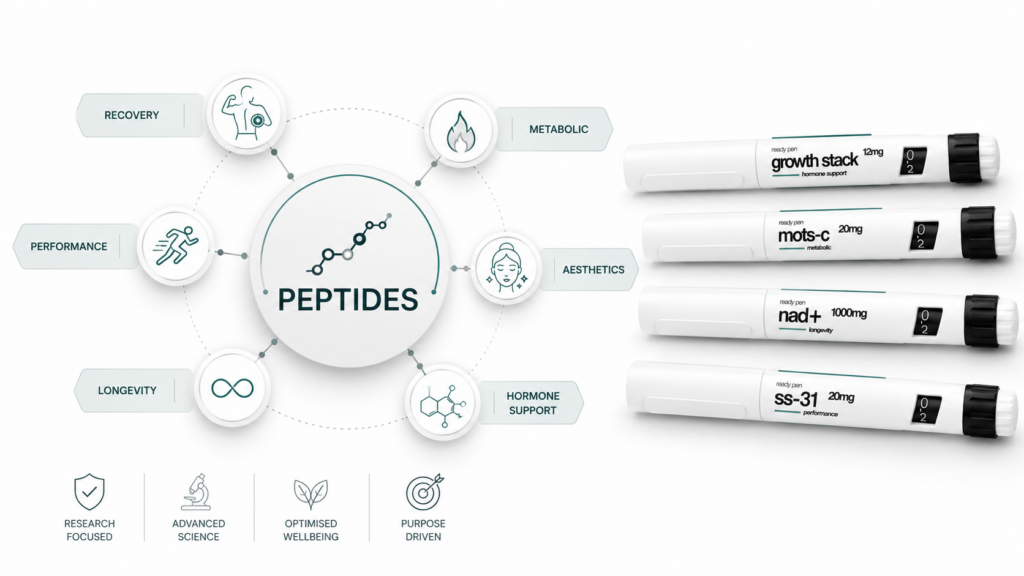
Recovery peptides are commonly explored in relation to tissue support, physical resilience, mobility, and active lifestyles.
These compounds are often researched by individuals interested in supporting recovery following exercise, physical activity, or everyday wear and tear.
One of the most recognised recovery-focused peptides. BPC-157 is commonly explored for recovery support, mobility, and digestive wellness.
TB-500 is frequently explored for tissue support, flexibility, mobility, and physical resilience.
Combining recovery-focused compounds into a single protocol, the Recovery Stack is commonly associated with comprehensive recovery support and active lifestyles.
Performance peptides are commonly explored by individuals interested in energy production, physical performance, recovery, and training support.
These compounds are often discussed within fitness, athletic, and performance-focused communities.
MOTS-c is commonly associated with energy regulation, metabolic efficiency, and exercise performance.
A combination protocol frequently explored in relation to recovery, performance, and body composition goals.
Longevity-focused compounds are commonly explored for healthy ageing, cellular health, mitochondrial function, and long-term wellness.
These compounds have become increasingly popular within the growing longevity and preventative wellness movement.
NAD+ is a naturally occurring coenzyme involved in cellular energy production and is widely discussed within longevity-focused communities.
SS-31 is commonly explored in relation to mitochondrial function and cellular energy support.
Due to its association with metabolic regulation and mitochondrial health, MOTS-c is often included within longevity-focused protocols.
Metabolic peptides are commonly explored in relation to appetite regulation, body composition, energy expenditure, and metabolic wellness.
These compounds have attracted significant attention in recent years due to growing interest in metabolic health and weight management research.
Retatrutide is commonly explored for appetite support, metabolic wellness, and body composition-focused protocols.
MOTS-c is also frequently discussed in relation to metabolic efficiency and energy regulation.
Aesthetic peptides are commonly explored for skin appearance, complexion support, tanning research, and appearance-focused wellness protocols.
GHK-Cu is one of the most widely recognised compounds explored for skin appearance and aesthetic-focused protocols.
A multi-compound protocol commonly associated with appearance-focused wellness routines.
MT2 is commonly explored in relation to tanning research and pigmentation-focused studies.
Hormone support peptides are commonly explored in relation to growth hormone pathways, recovery, body composition, and overall wellness.
These compounds are frequently discussed within performance and healthy ageing communities.
One of the most commonly explored hormone-support protocols within the peptide space.
Frequently explored in relation to growth hormone pathways and body composition support.
The most appropriate category often depends on your goals and interests.
Those focused on recovery may explore compounds within the Recovery category, while individuals interested in healthy ageing may begin with Longevity-focused compounds.
Many experienced users eventually explore multiple categories depending on their objectives and protocol preferences.
Understanding the categories is often the best first step before researching individual compounds in greater detail.
Explore more educational resources within The Simple Peptide Knowledge Centre:
The more informed your research, the easier it becomes to understand the differences between compounds and identify the information most relevant to your interests.

No matching compounds found.
Try searching by benefit, category or peptide name.