
Premium quality.
Honest pricing.
Expert guidance.
Premium quality.
Honest pricing.
Expert guidance.
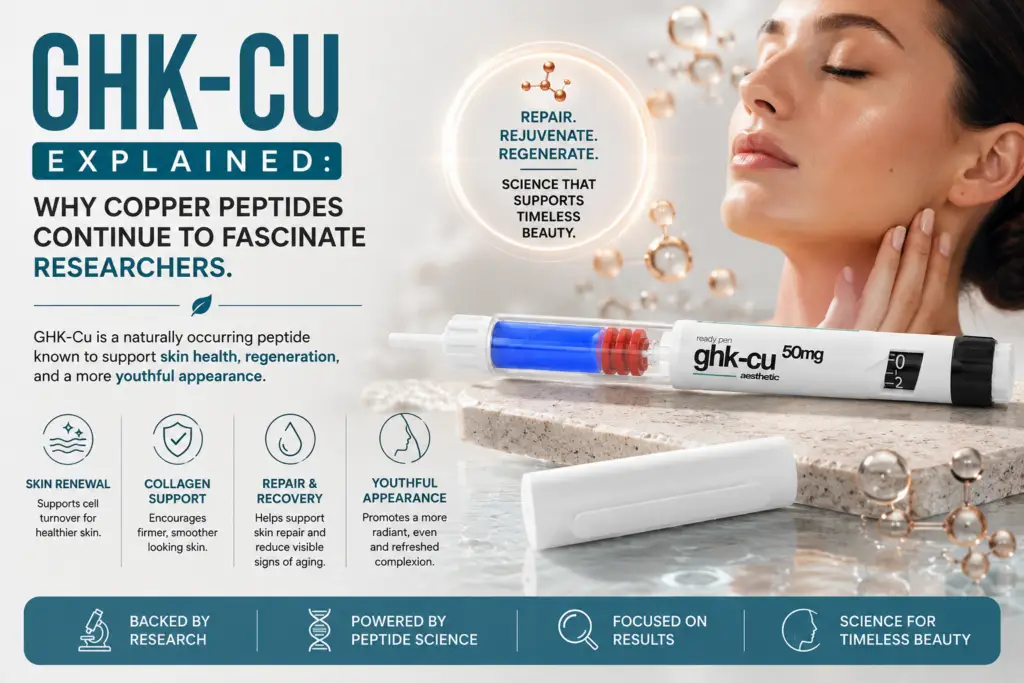
Few compounds in peptide research have attracted attention across as many scientific disciplines as GHK-Cu. First identified in human plasma in the 1970s, this naturally occurring copper-binding peptide has since been investigated for its role in cellular communication, tissue biology, and healthy ageing.
Unlike many peptides that are explored within a single area of research, GHK-Cu has been studied in relation to skin biology, connective tissue, hair research, and broader regenerative processes. This wide range of scientific interest has made it one of the most recognised peptides in aesthetic and longevity research.
Today, researchers continue to investigate GHK-Cu because of its unique relationship with copper—a mineral essential for many normal biological processes.
This guide explains what GHK-Cu is, why it has become a major area of scientific interest, and how it fits within modern peptide research.
✔ GHK-Cu is a naturally occurring copper-binding peptide.
✔ Researchers commonly investigate its relationship with skin biology and connective tissue.
✔ It is one of the best-known peptides in aesthetic research.
✔ Scientific interest also extends to healthy ageing and tissue biology.
✔ Research continues to evolve across multiple fields.
| Feature | Information |
|---|---|
| Category | Aesthetics |
| Compound | GHK-Cu |
| Research Focus | Skin biology, connective tissue, healthy ageing |
| Delivery System | Ready Pen |
| Related Product | GHK-Cu 50mg Ready Pen |
| Related Guides | Aesthetic Peptides Explained (coming soon), Glow Stack Guide (coming soon) |
GHK-Cu (Glycyl-L-Histidyl-L-Lysine Copper) is a naturally occurring peptide that binds with copper ions.
It was first identified in human plasma and is also found in saliva and urine. Researchers believe naturally occurring levels of GHK-Cu may change with age, contributing to growing scientific interest in its biological role.
Because copper is involved in many normal cellular processes, researchers continue to investigate how GHK-Cu may influence communication between cells and support healthy tissue biology.
Scientific interest in GHK-Cu extends across several areas of research.
Researchers continue to investigate its relationship with:<ul> <li>Skin biology</li> <li>Connective tissue</li> <li>Collagen-related pathways</li> <li>Hair biology</li> <li>Healthy ageing</li> <li>Cellular communication</li> </ul>
This broad research profile makes GHK-Cu one of the most versatile compounds in peptide science.
Current research suggests GHK-Cu functions as a signalling peptide.
Rather than acting as a structural component itself, researchers believe it helps influence cellular communication involved in normal tissue maintenance and repair processes.
Scientists continue to investigate how GHK-Cu interacts with biological pathways associated with extracellular matrix biology, collagen-related processes, and cellular regeneration.
Although many questions remain, this signalling role has made GHK-Cu an important focus of ongoing research.
Researchers commonly investigate GHK-Cu because of its relationship with healthy skin structure and appearance.
Scientific interest extends to connective tissue biology and the cellular processes involved in maintaining normal tissue integrity.
Researchers continue to explore GHK-Cu within studies investigating hair biology and follicle function.
Because tissue biology changes with age, GHK-Cu is also frequently discussed within longevity and healthy ageing research.
GHK-Cu has been studied for several decades, making it one of the longest-researched peptides in this field.
Researchers have explored its biological activity across laboratory, preclinical, and clinical settings to better understand its relationship with tissue biology, skin research, and healthy ageing.
Its broad scientific relevance has helped establish GHK-Cu as one of the most recognised peptides in aesthetic research.
Unlike many peptides that focus on a single biological pathway, GHK-Cu has attracted attention because researchers continue to investigate its potential role across multiple systems.
Current areas of scientific interest include:
This broad research profile continues to generate interest within both aesthetic and longevity science.
Although GHK-Cu is best known for its association with skin research, scientists increasingly discuss it within the broader context of healthy ageing.
Researchers continue to explore how maintaining healthy cellular communication and tissue biology may contribute to normal ageing processes.
For this reason, GHK-Cu is often mentioned alongside other longevity-focused compounds such as NAD+, MOTS-C and SS-31, despite each having different mechanisms and research objectives.
Yes. GHK-Cu is naturally produced within the human body and binds with copper ions.
Researchers commonly explore GHK-Cu in relation to skin biology, connective tissue, collagen-related pathways, hair biology and healthy ageing.
Copper is an essential mineral involved in many biological processes. GHK-Cu naturally binds to copper, which is central to its biological activity.
No. Although skin biology is one of the most recognised research areas, scientists also investigate GHK-Cu in relation to connective tissue, hair biology and healthy ageing.
GHK-Cu is generally categorised within aesthetic peptide research, but it is also frequently discussed within longevity science because of its relationship with healthy tissue biology.
You may also find these guides helpful:
GHK-Cu products supplied by The Simple Peptide are intended for research and educational purposes only.
The information contained in this guide is provided for educational purposes and should not be interpreted as medical advice. Research compounds are not intended to diagnose, treat, cure or prevent any disease.

No matching compounds found.
Try searching by benefit, category or peptide name.