
Premium quality.
Honest pricing.
Expert guidance.
Premium quality.
Honest pricing.
Expert guidance.
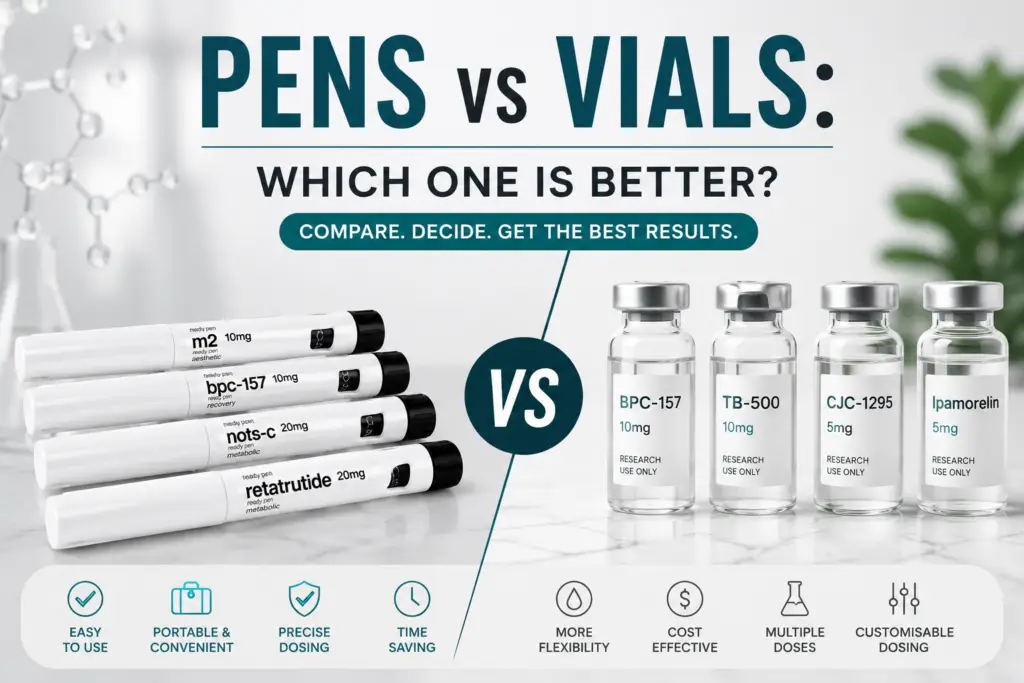
When researching peptides, one of the first decisions you’ll encounter is the delivery system. Research peptides are commonly supplied in one of two formats: traditional vials or peptide pens.
Both systems are widely used within peptide research and each has its own advantages. The right option often depends on the research protocol, the level of experience, and personal preferences.
This guide compares peptide pens and vials, explains the advantages and limitations of each, and highlights the factors researchers commonly consider when choosing between the two.
Traditional peptide vials contain either a lyophilised (freeze-dried) peptide powder or a pre-prepared liquid solution, depending on the product.
When supplied as a powder, the peptide must first be reconstituted using bacteriostatic water before it can be measured and administered using a syringe.
For many experienced researchers, this has long been the traditional method of working with peptides.
Peptide pens are integrated delivery systems designed to simplify peptide administration.
Depending on the product, they may arrive pre-filled and ready to use or utilise a dual-chamber system that automatically mixes the peptide immediately before first use.
Once prepared, the required dose is selected using a click-based dosing mechanism before attaching a fresh needle.
At The Simple Peptide, our range includes both Ready Pens (pre-filled) and coming soon: Fusion Pens (dual-chamber technology) to suit different compounds and research protocols.
| Feature | Peptide Pens | Traditional Vials |
|---|---|---|
| Ease of Use | Excellent | Moderate |
| Dose Consistency | High | Depends on preparation and measurement |
| Preparation Required | Minimal | Reconstitution is required |
| Equipment Needed | Pen needle | Syringe, needle, bacteriostatic water (where applicable) |
| Portability | Excellent | Moderate |
| Suitable For Beginners | Yes | Learning curve |
| Flexible Concentrations | Limited | Greater flexibility |
Pens are designed to reduce preparation steps and make dosing straightforward.
Click-based dosing systems help deliver consistent measurements without requiring manual calculations for every administration.
With fewer preparation steps, pens can provide a faster and more streamlined experience.
Pens generally require only a new sterile pen needle, whereas vial-based systems may require additional equipment depending on the product.
For individuals new to peptide research, pen systems often provide an easier introduction due to their straightforward operation.
Traditional vials continue to play an important role in peptide research.
They remain a popular choice for experienced researchers who prefer greater flexibility.
Researchers can prepare different concentrations depending on their protocol requirements.
Many laboratories and experienced researchers have long used vial-based systems and are comfortable with the preparation process.
Historically, vials have been the most common delivery format within peptide research.
There is no single answer.
Both delivery systems are capable of supporting peptide research, and each has advantages depending on the researcher’s experience and protocol.
Many experienced researchers continue to prefer traditional vials because they appreciate the flexibility they provide.
Others choose peptide pens because they value convenience, consistency, and a simplified dosing experience.
The best option depends on the priorities of the individual researcher.
At The Simple Peptide, we chose premium pen technology because we believe a simpler research experience can improve confidence and consistency.
Our Prime and Fusion Pens are designed to minimise preparation, simplify dosing, and provide a premium user experience without unnecessary complexity.
Rather than replacing traditional vials, our goal is to offer an alternative delivery system for researchers who value convenience and ease of use.
Many researchers find pen systems easier because they reduce preparation steps and provide click-based dosing.
Yes. A new sterile pen needle should be attached for each administration.
Many beginners choose pens because they are designed to simplify preparation and dosing.
Not always. Some peptides are supplied as liquid formulations, while many research peptides are supplied as lyophilised powders that require reconstitution before use.
Pen systems are designed to provide consistent, repeatable dosing. However, accuracy ultimately depends on correct preparation and use of the delivery system.
You may also find these guides helpful:
This information is provided for educational and research purposes only. It is not intended to diagnose, treat, cure, or prevent any disease.

No matching compounds found.
Try searching by benefit, category or peptide name.