Premium quality.
Honest pricing.
Expert guidance.
Premium quality.
Honest pricing.
Expert guidance.
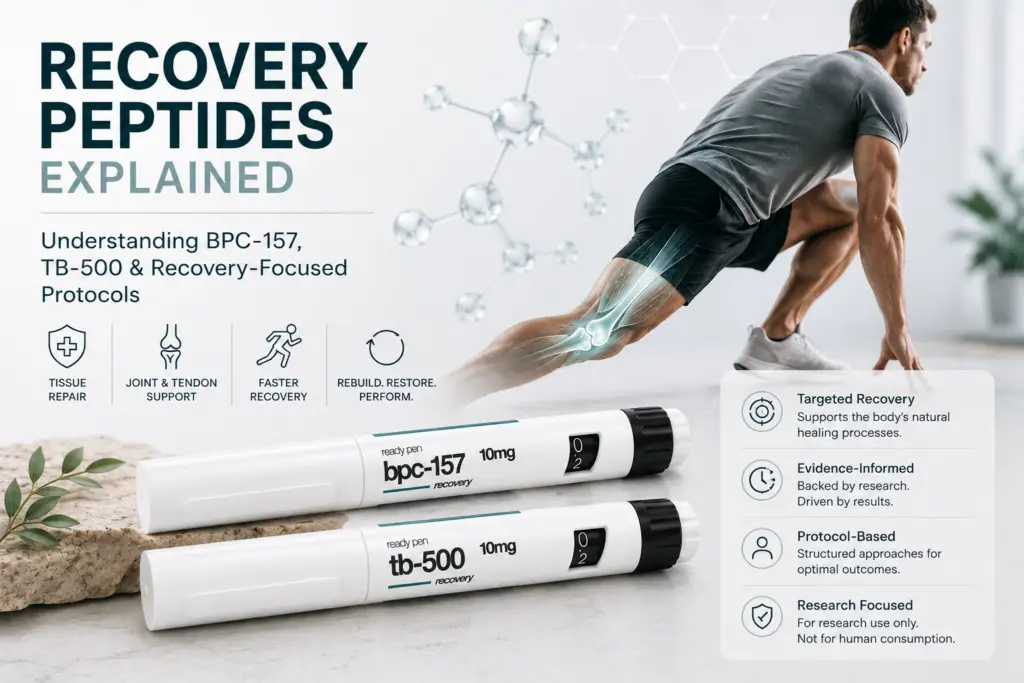
Recovery is one of the most popular areas of peptide research. Whether the focus is physical activity, mobility, active lifestyles, or structured recovery protocols, recovery-focused peptides continue to attract significant interest from researchers and wellness communities alike.
Among the many compounds available today, BPC-157 and TB-500 are two of the most recognised peptides associated with recovery-focused research.
This guide explores what recovery peptides are, how they are commonly categorised, and the compounds most frequently discussed within this area.
Recovery peptides are compounds commonly explored in relation to tissue support, physical resilience, mobility, and recovery-focused biological processes.
Unlike metabolic peptides, which are often associated with appetite regulation and body composition, or longevity peptides, which are explored for cellular health and healthy ageing, recovery peptides are primarily discussed in relation to maintaining an active lifestyle.
Many individuals begin their peptide research journey within the recovery category because the intended purpose is often easy to understand.
Several factors contribute to the popularity of recovery-focused compounds.
Recovery peptides are frequently explored by individuals who maintain active lifestyles and wish to support structured recovery routines.
Researchers have investigated recovery-focused peptides across a variety of biological systems and pathways.
Many recovery peptides are commonly discussed together, creating structured protocols that focus on multiple recovery-related mechanisms.
BPC-157 is one of the most recognised recovery peptides available today.
Derived from a protective protein sequence found within the stomach, BPC-157 has become widely associated with recovery-focused research.
Read our complete BPC-157 Guide.
TB-500 is another well-known peptide commonly discussed within recovery-focused protocols.
Researchers have explored TB-500 in relation to mobility, flexibility, tissue support, and physical resilience.
Read our complete TB-500 Guide.
Because BPC-157 and TB-500 are frequently discussed together, many individuals explore recovery stack protocols that combine both compounds within a single structured approach.
The goal of these protocols is not necessarily to focus on a single pathway, but rather to explore multiple recovery-related mechanisms simultaneously.
For this reason, recovery stacks remain among the most popular peptide combinations within the recovery category.
One of the most common questions asked by beginners is:
“Which is better: BPC-157 or TB-500?”
The answer depends on the objectives of the research protocol.
Both compounds are frequently associated with recovery support, but they are distinct peptides with different characteristics and research histories.
Many researchers choose to explore both compounds together rather than viewing them as direct competitors.
Recovery-focused compounds are often discussed by:
As always, research objectives vary from person to person.
Recovery peptides are compounds commonly explored in relation to recovery support, mobility, physical resilience, and active lifestyles.
BPC-157 and TB-500 are among the most recognised recovery-focused peptides.
Many recovery-focused protocols commonly discuss combining BPC-157 and TB-500 within a structured recovery stack.
No. Recovery-focused research attracts interest from a wide range of individuals and communities.
Many beginners start by understanding the differences between BPC-157 and TB-500 before exploring individual compound guides.
Recovery peptides represent only one category within the broader peptide landscape.
You may also wish to explore:
Understanding how each category differs is often the best way to build a strong foundation of peptide knowledge.
This information is provided for educational and research purposes only. It is not intended to diagnose, treat, cure, or prevent any disease.

No matching compounds found.
Try searching by benefit, category or peptide name.