Premium quality.
Honest pricing.
Expert guidance.
Premium quality.
Honest pricing.
Expert guidance.
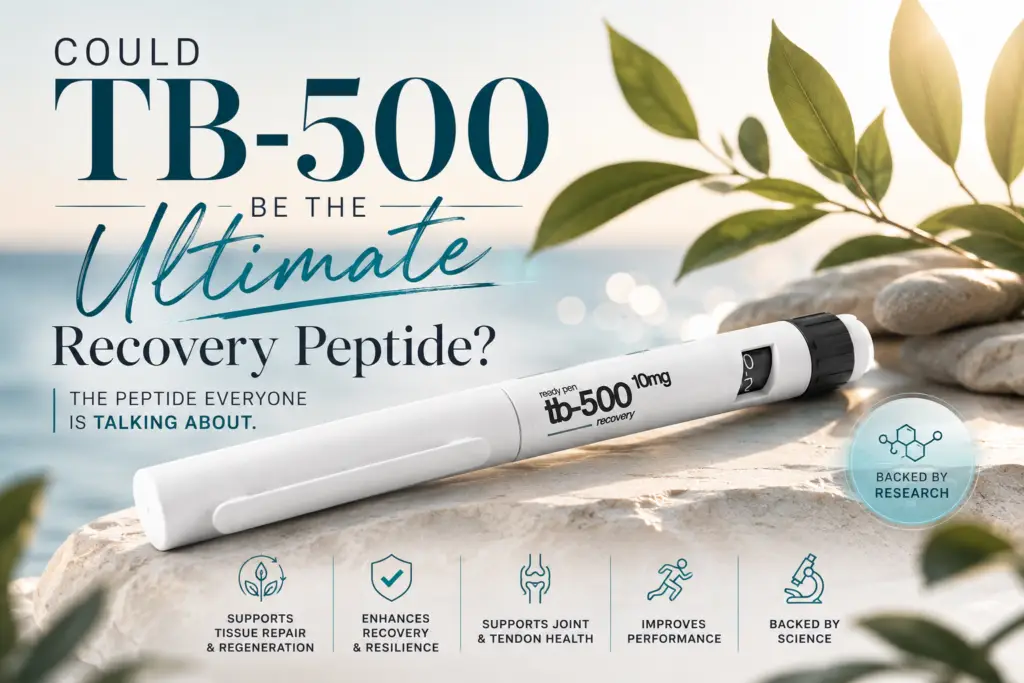
TB-500 is one of the most recognised peptides within recovery-focused research. Known for its association with mobility, physical resilience, and active lifestyles, it has become a popular compound among researchers exploring recovery-related pathways.
Over the years, TB-500 has gained attention within fitness, performance, and wellness communities due to its unique biological origins and broad research interest.
This guide explains what TB-500 is, how it works, areas commonly explored in research, and why it remains one of the most discussed recovery-focused peptides.
TB-500 is a synthetic peptide derived from a naturally occurring protein known as thymosin beta-4 (Tβ4).
Thymosin beta-4 is found throughout the body and plays a role in a variety of biological processes. Researchers became interested in specific segments of this protein due to their potential involvement in cellular movement, tissue maintenance, and recovery-focused mechanisms.
TB-500 was developed as a synthetic peptide that captures a portion of these biological characteristics and has since become widely explored in recovery-related research.
Research suggests TB-500 may interact with pathways involved in cellular movement, tissue support, and recovery-focused biological processes.
Researchers have explored its relationship with:
Because these pathways are involved in multiple systems throughout the body, TB-500 has become a peptide of interest across a wide range of research areas.
TB-500 is frequently explored for:
One of the most common areas of interest involves recovery-focused protocols and physical resilience.
Researchers often investigate TB-500 in relation to flexibility, movement, and mobility-focused applications.
TB-500 is commonly discussed within communities interested in training, exercise, and physical activity.
Many researchers explore TB-500 as part of broader recovery-focused protocols designed to support an active lifestyle.
Several factors contribute to TB-500’s popularity within peptide research.
TB-500 has been explored across multiple areas of recovery-focused research.
It is frequently associated with mobility support, active lifestyles, and physical resilience.
TB-500 is commonly mentioned together with BPC-157 due to their popularity within recovery-focused protocols.
Researchers continue to investigate TB-500 across a variety of biological pathways and systems.
TB-500 and BPC-157 are among the most frequently discussed recovery-focused peptides.
Although they are distinct compounds with different origins and mechanisms, they are often explored together within structured recovery protocols.
Because of this, many researchers view the two compounds as complementary rather than competing options.
Learn more in our BPC-157 Guide.
Research involving TB-500 has explored areas including:
As with all research compounds, findings vary depending on study design, dosage, methodology, and research objectives.
Ongoing investigation continues to expand understanding of this peptide.
TB-500 is a synthetic peptide derived from thymosin beta-4, a naturally occurring protein found throughout the body.
Yes. TB-500 is a synthetic peptide commonly explored within recovery-focused research.
TB-500 is commonly explored for recovery support, mobility support, physical resilience, and active lifestyles.
Yes. TB-500 is frequently discussed alongside BPC-157 within recovery-focused protocols.
Its popularity stems from its broad research interest and its association with mobility, recovery support, and active lifestyles.
Frequently explored alongside TB-500 within recovery-focused protocols.
A combination protocol commonly associated with recovery support and active lifestyles.
You may also find these guides helpful:
TB-500 is supplied for research and educational purposes only.
This guide is intended for informational purposes and does not constitute medical advice. Research compounds are not intended to diagnose, treat, cure, or prevent any disease.

No matching compounds found.
Try searching by benefit, category or peptide name.