
Premium quality.
Honest pricing.
Expert guidance.
Premium quality.
Honest pricing.
Expert guidance.
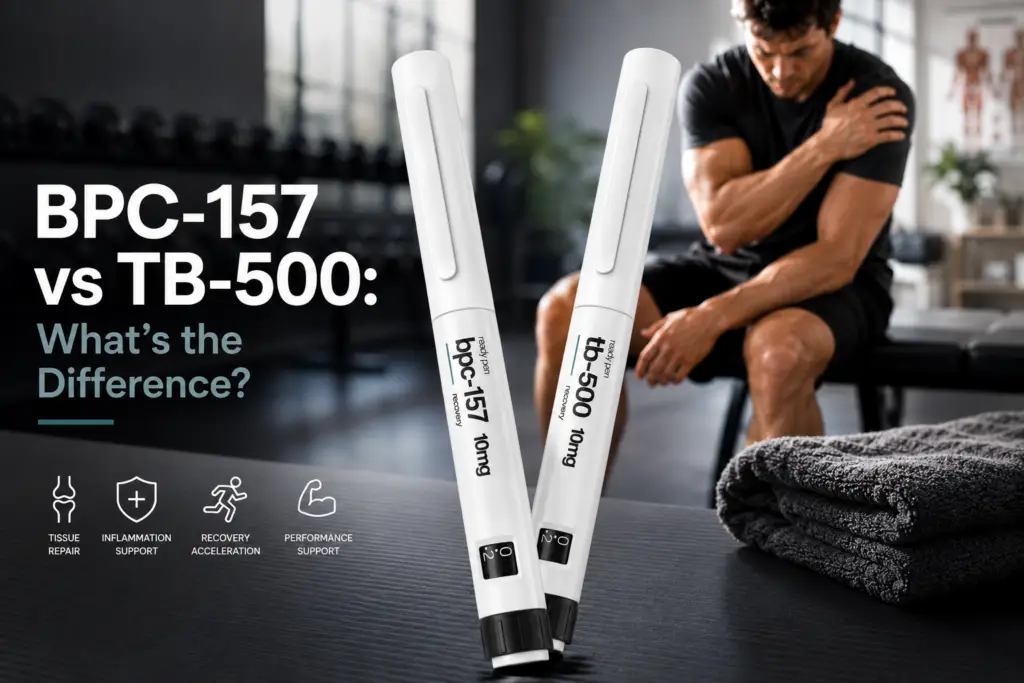
BPC-157 and TB-500 are two of the most recognised recovery-focused peptides in modern research. Because they are frequently discussed together, one of the most common questions is:
“What’s the difference between BPC-157 and TB-500?”
While both compounds are commonly associated with recovery-focused research, they are distinct peptides with different biological origins, characteristics, and areas of scientific interest.
This guide compares BPC-157 and TB-500 to help you better understand each compound and how they are commonly explored within research settings.
| Feature | BPC-157 | TB-500 |
|---|---|---|
| Origin | Derived from a protective gastric protein | Derived from thymosin beta-4 |
| Research Focus | Recovery support, mobility, digestive wellness | Recovery support, mobility, physical resilience |
| Common Category | Recovery | Recovery |
| Often Combined? | Yes | Yes |
BPC-157 is a synthetic peptide derived from a naturally occurring protective protein sequence found within gastric juice.
Researchers commonly explore BPC-157 in relation to:
Its broad research profile has made it one of the most recognised peptides within the recovery category.
TB-500 is a synthetic peptide derived from thymosin beta-4, a naturally occurring protein found throughout the body.
Researchers commonly explore TB-500 in relation to:
It has become one of the most widely recognised recovery-focused compounds within peptide research.
Although BPC-157 and TB-500 are often discussed together, they differ in several important ways.
BPC-157 originates from a protective gastric protein, whereas TB-500 is derived from thymosin beta-4.
BPC-157 has attracted research interest in both recovery-focused and digestive-related pathways.
TB-500 is more commonly discussed in relation to mobility, physical resilience, and tissue-support mechanisms.
While there is some overlap, researchers often investigate each compound for slightly different biological pathways and mechanisms.
One of the reasons BPC-157 and TB-500 are frequently mentioned together is that researchers often explore them within the same recovery-focused protocols.
Rather than viewing them as competing compounds, they are commonly discussed as complementary peptides that investigate different biological mechanisms.
For this reason, many recovery-focused protocols include both compounds as part of a broader research approach.
There is no universal answer.
The most appropriate compound depends entirely on the objectives of the research being undertaken.
Some researchers focus on BPC-157.
Others explore TB-500.
Many investigate both together because each peptide has unique characteristics and areas of scientific interest.
Understanding the differences between the two compounds is often more valuable than attempting to determine which one is “better.”
No. They are different synthetic peptides with different biological origins and areas of research.
Yes. They are frequently discussed together within recovery-focused research protocols.
The compounds have different characteristics and research focuses, so direct comparisons are not straightforward.
Both compounds are commonly grouped within the Recovery peptide category.
Recovery peptides are just one area of peptide research.
You may also wish to explore:
Building an understanding of the broader peptide landscape can help place individual compounds into context.
This information is provided for educational and research purposes only. It is not intended to diagnose, treat, cure, or prevent any disease.

No matching compounds found.
Try searching by benefit, category or peptide name.